


It is difficult to understand how this 1933 racy (this means erotic by 1930s standards) romantic drama ended up being a box-office failure. Here you have one of the most beautiful women in the world, Greta Garbo, playing an amorous 17th century Swedish queen who risks her crown for love. In addition, you have John Gilbert playing her tragic lover—the same John Gilbert she jilted at the altar in 1926. Anyone who read the film magazines back then surely knew Laurence Olivier was supposed to star opposite Garbo, and that it was only after her insistence that Gilbert was given the role. With so much backstory, who could resist this film? Evidently Americans who were too depressed about the Great Depression to watch a tragic romance.
Rouben Mamoulian directed this very loose with the facts historical drama. Screenwriters S.N. Behrman and H.M. Harwood obliviously didn’t read a Swedish history primer, because there are a number of glaring historical inaccuracies (ah, but it was for dramatic effect, so what the heck). The real Christina did not abdicate because of love (or the death of a lover), but
because she wanted to practice Catholicism instead of state sanctioned Lutheranism. However, they did get it right when they hinted at Christina’s lesbian leanings in regards to Ebba (Elizabeth Young), her lady-in-waiting—see the mouth-to-mouth kiss they share in this film (obviously the censor was a man).
Christina ascends to the throne at a very young age after the death of her father, King Gustavus. Her regent, Lord Chancellor Oxenstierna (Lewis Stone), wants to marry her off to her cousin, Prince Charles (Reginald Owen). Prince Charles is a national war
hero and highly revered by the Swedish people. But Christina could care less about Prince Charles and his endless desire to wage war (actually she has a problem with the warmongering). In the palace she has any number of consorts, namely Count Magnus (Ian Keith) and Countess Ebba. Hence, she knows she will not die an old maid, but as she proclaims a “bachelor”. Still, she is a bit hurt when Ebba tells her fiancee that the queen is too domineering. With too much court intrigue and a bit of a bruised ego, Christina finds herself yearning for a change of scenery. And, this brings her to her first meeting with the Spanish envoy, Don Antonio (Gilbert).
Traveling incognito with her trusted bodyguard, Aage (C. Aubrey Smith), she happens upon the Spanish envoy, whose carriage is stuck in the snow. After coming to Don Antonio’s assistance she suggests he spend the night at the nearest inn. This is where things get spicy. Don Antonio mistakenly thinks she’s a boy (she’s dressed like one and has a pageboy haircut), so he thinks nothing of sharing the only available room at the inn with her.
Ah, but why is he strangely attracted to this young man? He soon learns when she undresses in front of a roaring fire. To say he was pleased would be an understatement. They spend the next several days locked in this room enjoying amorous endeavors under fur bedcovers. Where were the censors—in a breadline? Somehow in all of this, she forgets to mention she is the Queen of Sweden.
Instead, the queen thinks they should be properly introduced when he comes to court. Ah, the shocked look Gilbert displays in this scene is priceless. Though he feels slightly used and ridiculed, he eventually forgives her and they consort with one another at court. But there are problems looming: Don Antonio is a Catholic; Count Magnus is jealous; and, the Swedish people want her to marry Prince Charles. The people are so upset that they storm the palace and have to be subdued by the queen herself. Court Magnus is so jealous that he kidnaps Don Antonio and forces Christina to sign a passport for her lover’s return to Spain. This act leads her to abdicate the throne for love and to set her off on a journey to the frontier to meet Don Antonio. Too bad Don Antonio has been mortally wounded in a duel with Magnus—at
least he waits to die in her arms. That’s something, right? She did give up a crown and kingdom for him after all, the least he could do is wait to bleed to death in front of her. Thus, this brings us to the climatic final shot (by cinematographer William Daniels) of Christina on a boat taking her slain lover home to Spain. A glowing, close-up of Garbo’s marvelous face looking out into nothingness. Yeah, I’d say this film could be considered a real downer for Depression-era Americans.
What I like about this film is how wickedly risqué it is. The dialogue is double entendre laced. The love scenes are daring and erotic (for the 1930s), and you have directly hinted at references to homosexuality. It is hard to believe this film was released in 1933. While Camille and Ninotchka are Garbo’s best films, this is her most daring. It is also the film that comes closest to resembling who Garbo was off-screen.
Tuesday, October 19, 2010


Monday, June 14, 2010

A classic psychological film noir, Laura is one of the best films Otto Preminger ever made. Yet, the plot of Laura seems quite simple when you compare it to the behind the scenes plot that unfolded daily at 20th Century Fox. First Preminger was to direct; then studio head Darryl Zanuck fired him and replaced him with Rouben Mamoulian. Then Mamoulian was fired (nothing new for him) and Preminger was rehired. Then they argued over the cast. Zanuck wanted John Hodiak to play Detective McPherson and Preminger wanted Dana Andrews. Zanuck also tried to put the nix on Clifton Webb (who ended up being nominated for a Best Supporting Actor Oscar) and first-time cinematographer Joseph LaShelle (who won the film’s only Academy Award for his photography), who replaced Lucien Ballard after Mamoulian was fired. In the end, Preminger won most of the battles and his film garnered five Academy Award nominations, including Best Director, Best Art Direction (Lyle R. Wheeler, Leland Fuller, and Thomas Little), and Best Screenplay (adapted from the Vera Caspary novel of the same name by Jay Dratler, Samuel Hoffenstein and Betty Reinhardt).

The film opens with that haunting theme song and a shot of an even more haunting portrait of a woman we soon learn, via voiceover by society columnist Waldo Lydecker (Clifton Webb), 

Later, Lydecker and McPherson head off to dine at Waldo and Laura’s special table, where Lydecker reminisces (via flashback) of happier days. They’d met five years earlier when career-minded Laura had asked him to endorse a pen promoted by her advertising agency. At first he had snubbed her, but then he changed his mind and not only endorsed the pen but decided to make her his protégé. From that point on, Lydecker was in the business of molding Laura into the most unforgettable woman ever. 
Back at Laura’s apartment, McPherson encounters the maid, Bessie Clary (Dorothy Adams), who reveals she found a cheap bottle of whiskey in Laura’s bedroom the night she was killed. He also encounters the gruesome threesome who have come to determine what belongs to whom. Lydecker wants a few things back that he “lent” Laura: an antique fire screen, a “priceless” vase, and the same grandfather clock he already has in his own apartment.


While McPherson is checking out Lydecker’s apartment and finally realizing that the grandfather clock in Laura’s own apartment might hold the murder weapon, Laura is being verbally reprimanded by Lydecker in her apartment for her possible attraction to the detective. So, when the detective arrives at her apartment and Laura gives Lydecker the heave-ho, Lydecker is politely furious. When he leaves the apartment he casts a large shadow on the wall—foreboding? As soon as Lydecker’s gone, 

The story itself is marvelous. You have a case of mistaken identity with the murder and the shocking reappearance of the murder victim. I would have liked to have been in the audience when Gene Tierney turned that light on back in 1944—I’m sure it startled some.
Besides the wonderful plot, you have a no-nonsense detective who becomes obsessed with his beautiful dead victim and a whole cast of venomous creatures. The callousness of Judith Anderson’s Aunt Anne is both appalling and delightful to watch. Vincent Price’s interpretation of a Southern ladies man is quite comical. Gene Tierney plays the femme fatale well by exuding an icy coolness that just scorches the screen at times. And, when it comes to Clifton Webb, it is difficult to believe this was his first sound film. Webb is just delightful as a bitter, homosexual who hates all masculine men and will stop at nothing to keep them away from his Laura. There are many ways to look at his obsession with Laura. Personally, I think he created her to be the woman he wished he could be (his other self) and didn’t want anyone to come between them because he would be separated from his one true love: his feminine self. But that’s just my theory, I’m sure you have your own. Whatever may be the case, this is a classic film noir.
Friday, January 22, 2010

But what about tomorrow?
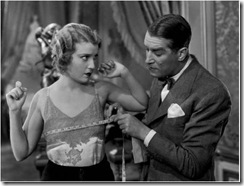
Directed by Rouben Mamoulian, this 1932 romantic musical set the bar very high for subsequent musicals. Many critics cite it as one of the greatest and innovative musicals of the 1930s. Song and dialogue are cleverly woven together to tell the unlikely love story of a very frustrated Princess Jeanette (Jeanette MacDonald) and a handsome Parisian tailor named Maurice (Maurice Chevalier).
The beginning of the film is unforgettable, with a symphony of noises that captures the sounds of an awakening Paris and Chevalier singing “That’s the Song of Paree”. We learn that Maurice has just completed a job that will establish him as a first-rate tailor: 15 suits for the Viscount de Varese (Charlie Ruggles). The problem is the viscount can’t pay h
The Princess it would seem is very unhappy and well, sexually frustrated. Just 22, she is the widow of a very old man. If she is to marry again she must find someone of equal royal rank, but this holds problems in itself, as there are only two eligible suitors: ages 85 and 12. What is an attractive widow to do?
While the Princess is busy being bored at the chateau, Maurice decides to take the Count’s 1
All together there are nine fantastically staged musical numbers by Richard Rogers and Lorenz Hart. The songs are extremely catchy. If you have seen this film, you might just be humming “Mimi” or “Isn’t It Romantic” as you read this. 
If you love musicals, you will love this movie. A thoroughly enjoyable classic.


