movies

  • Subscribe to our RSS feed.
  • Twitter
  • StumbleUpon
  • Reddit
  • Facebook
  • Digg
Showing posts with label 1932. Show all posts

Saturday, October 9, 2010

Freaks (1932) **

Posted on 3:51 PM by Unknown

freaks-poster

The title of this classic 1932 film is not what one might call politically correct. There are few films in all of cinema that can be classified in the horror realism genre (one might think of The Blair Witch Project or the original Texas Chainsaw Massacre, but they are severely flawed wannabes). Yet, director Tod Browning’s Freaks is one of those few films that blends realism with horror. The freaks in the film’s title are actual 1930s carnival and circus freaks, with all of their deformities on full display. It is said that Browning had the largest casting call of professional freaks ever, and it shows. When watching this film one can’t help but be disturbed by some of the afflictions of these “freaks.” Quite frankly, this is an odd, disturbing film. The film was so shocking that it was actually banned in a number of places. It was later rediscovered on the art house circuit and today is a common staple of TCM’s October schedule.

Browning, of course, is most known for directing Bela Lugosi in the original Dracula (1931). Yet, many film critics consider Freaks to be his masterpiece (not that there was much to choose from) because of his unflinching presentation of another strange reality unfamiliar to the common moviegoer. freaks-1932-director-tod-browningI tend to agree with the critics on this one. In regards to the horror genre, I find Freaks much creepier and frightening than Dracula. Now, if you want to see a truly frightening take on the vampire myth watch Nosferatu: A Symphony of Terror (1922).

The film opens with a carnival barker explaining the events that led to the beautiful “Peacock of the Air”, trapeze artist Cleopatra’s (Olga Baclanova) horrible current state. At this moment, one might prepare oneself for watching a trapeze act gone terribly bad—one would be wrong. Instead, one is treated to one of the freaks2strangest downfalls in all of cinema history. It would seem that Hans (Harry Earles), a wealthy carnival dwarf (don’t ask why he works in a carnival if he’s rich, just go with it) is smitten with Cleopatra. Her beauty and “normalness” makes Hans forget all about his dwarf fiancé Frieda (Daisy Earles). Seeing an easy way to rid themselves of the carnival life and all of the freaks they despise, Cleopatra and her strongman lover Hercules (cliché, anyone?) hatch an unsavory plot. By feigning love and admiration for Hans, Cleopatra convinces the dwarf that they should marry. This leads to one of the strangest wedding feasts ever.

The assembled guests at the wedding table consists of all freaks, sans Cleopatra and Hercules. This is a sight to behold. After consuming way too much alcohol, one of the freaks informs Cleopatra that she is now one of them. Oh, no you didn’t! This, of course, enrages Cleopatra and she launches into full bitch mode by calling her guests “dirty” and “slimy”. harry-earles-180As if that wasn’t enough, she belittles and demeans her new husband by carrying him around on her shoulders like a child or, even worse, a pet chimp. This does not bode well for the wedding night. Which, of course, leads to the reason why Cleopatra married him in the first place: so she and Hercules could kill Hans with poison and then run off with his money.

The scene where she informs Hans that she could never love a freak like him and that their marriage is a sham is difficult to watch. The look on Han’s face is just so pitiful. I suppose Harry Earles had a lot of past insults to draw from when it came to playing this scene. Shocked and humiliated, Hans collapses—of course, the poison didn’t help either. Counting their chickens before they’ve hatched (if you’ve seen this film, you know this is a sad attempt at a pun), Freaks1Hercules and Cleopatra freely discuss how many doses of poison it will take to kill Hans. When another freak overhears them, he goes for a doctor. Of course, the dose was so small that the doctor thinks it was an accident and he pronounces that Hans will make a full recovery with the aid of his medicine. Well, now you know that instead of giving Hans his medicine she’s going to substitute poison! In the end, the freaks band together and issue their own sadistic form of retribution. Hence, the grisly spectacle that the carnival barker is describing to the crowd: a legless squawking chicken-woman. What an ending… Oh, wait, yes, upon orders from MGM they had to tack on a happy ending with Hans and Frieda. Personally, the film should have ended with that shocking image of Cleopatra.

While this is not the greatest film you will ever see, it is an interesting watch. The pure shock value of some of the scenes is enough to warrant spending a mere 64 minutes watching Tod Browning’s best film.

Read More
Posted in **, 1932, Browning (Tod) | No comments

Monday, July 12, 2010

Me and My Gal (1932) **

Posted on 10:28 AM by Unknown

SM102-2T

If you haven’t ever seen or heard of Me and My Gal (1932) don’t be surprised. Until recently it was rarely shown on TV (now you can catch it occasionally on FMC) and it has not made it to DVD yet. As a result, it is one of those films that has been somewhat lost in the shuffle of the countless films of the Studio Era. It’s a small film, with a small plot.

Made prior to the repeal of Prohibition in 1933, this film openly glorifies the joyful effects of alcohol consumption. There is a running gag about an always-drunk fisherman (Will Stanton) who is forever getting into comical scrapes. In one particular scene he gets in a mimmiw fight with another drunk over the type of fish he has stolen. Yet, instead of using his fists he uses the fish as his weapon. Another scene finds a uproariously good time at a wedding, where guests drink beer out of a bootleg barrel and throw wirelesses out the window. The final shot of the film finds the father (J. Farrell MacDonald) of the film’s heroine (Joan Bennett) walking straight into the camera lens and asking, “Who’d like a drink, huh?” Pushing the envelope was nothing new for director Raoul Walsh, but it is still remarkable that he got away with some of the stuff he did in this film.

AW2AF00Z Working from a wisecracking script by Philip Klein, Barry Conners, and Arthur Kober, Walsh created a film that is difficult to define in terms of genre. It could be a comedy, crime drama, or an oddball romance—you pick!

Spencer Tracy stars as harbor cop Danny Dolan. Danny isn’t the brightest bulb on the Christmas tree, but he has a lot of the luck of the Irish. After rescuing a dog from a man who was going to drowned it because he couldn’t afford to feed it (a nod to the hard times of the Depression), Danny goes to the local chowder house to buy some bones and meets sarcastic cashier Helen Riley (Joan Bennett). They trade mutual barbs and it quickly becomes obvious they like one another. Later, when a drunk fisherman (Stanton) falls into the harbor Danny saves him and gets a promotion to detective for it. This promotion leads him to the sidewalk outside Helen’s house, where a radio has been thrown out Galthe window at a loud wedding reception (where lots of alcohol is consumed with great relish). Upon entering the apartment Danny finds that Helen’s sister Kate (Marion Burns) has just been married and he overlooks the drinking, which endears him to Helen. This is a fortuitous meeting in two ways: 1) Helen will go out with him now; 2) Kate is the ex-girlfriend of wanted mobster Duke Castenega. In the end, Danny will rescue Kate from the clutches of Duke and get yet another promotion and a large reward. With this large reward he will marry Helen and go to the Caribbean for his honeymoon.

The bantering relationship between Danny and Helen is fun to watch. Danny is a hard-boiled cop, who is always thinking of his next witticism. Helen is a strong-minded dame, who gives as good as she gets when it comes to Danny. There is one particular scene that stands out to me because of how cleverly it was done. While lying together on her sofa (her father had conveniently went to visit his meandmygal other daughter) the subject of some film comes up. In it, the characters do voiceovers to show the audience what they are really thinking. Walsh launches off this remark to do the same with his own characters. And, so as they are saying what they think the other one wants to hear, the audience gets to hear their real thoughts via voiceover. For example, when Danny makes a comment about Helen’s father being a fun, old guy she agrees, but she thinks aloud to the audience that if her father found them on the couch like they were that Danny would have to visit a doctor.

The acting is relaxed and the story is just strong enough to keep your attention. There is no amazing camerawork to speak of—as a matter of fact, there are a few parts that seem a bit jumpy. Yet, while it’s not the greatest film you’ll ever see, it is nonetheless an enjoyable 90 minutes. Plus, you get to see a very young Spencer Tracy and Joan Bennett show why they would go on to have very long careers.

Read More
Posted in **, 1932, Walsh (Raoul) | No comments

Saturday, May 29, 2010

Shanghai Express (1932) ***

Posted on 12:24 AM by Unknown

Jealousy, betrayal, obsession, passion…and this was only the fourth of the seven films Josef von Sternberg made with Marlene Dietrich. The title of their last film together: The Devil Is a Woman—coincidence? Ah, but this is not a review of the strange co-dependent relationship between director and actress. Instead, let's focus on the slightly less complicated romance between a fallen woman and a stiff-upper-lip Englishman.

As civil war is raging in China, a British surgeon, Captain Donald Harvey (Clive Brook) boards a train traveling from Peking to Shanghai, in order to reach the governor general, for whom he must perform brain surgery. Though the voyage could be perilous, his friends somehow envy him, as it is revealed that the notorious courtesan Shanghai Lily (Dietrich) is on board. Being a proper English gentleman, he’s never heard of her.

As chance would have it, onboard he meets a former lover, Magdalen, whom he hasn’t seen in five years. Things didn’t end well. She played games and tried to measure his love, and he was a jealous man who could only take so much before he left her. In the process of catching up, Magdalen informs Doc (as she affectionately calls him) that she has a new life and name. When asked if she’s married, a black-veiled Dietrich utters the classic line: "It took more than one man to change my name to Shanghai Lily." Um, awkward moment. Yet, it is obvious that they both still have feelings for one another—both good and bad.

Later, Doc learns from Reverend Carmichael (Lawrence Grant), who is troubled beyond measure about prostitutes traveling on the train, that Shanghai Lily had made one of his patients go insane and that there were countless others who’d had their lives ruined by her. I suppose at this moment Doc felt pretty foolish for carrying around a watch with her picture in it.

Meanwhile, there’s still a civil war going on in China. As such, government soldiers search the train and arrest the aide of Henry Chang (Warner Oland—yes, Charlie Chan!), a Eurasian merchant who is also a secret rebel leader. Angered by these actions, Chang sends a coded telegram to his rebels to attack the train at midnight. After securing the train, Chang takes Doc hostage so he can use him in exchange for his aide. He also offers to take Lily to his palace, but she declines, saying she’s out of the business. An eavesdropping Doc hears them, barges in and knocks Chang to the ground. This angers the rebel, but because he needs Doc alive, he does nothing and decides to take out his anger by raping Hui Fei (Anna May Wong), a friend and fellow prostitute of Lily’s.

Once his aide is released, Chang decides to exact revenge on Doc for his insolence by blinding the doctor. In order to save Doc’s eyesight, Lily offers to become Chang’s courtesan—just when she thought she was out, they pull her back in. Oblivious as ever, Doc’s old jealousies are ignited when he learns Lily is to stay with Chang. Fortunately, before this can happen, a revenge-seeking Hui Fei stabs Chang to death. However, this does not lessen the anger and resentment that Doc has toward Lily, whom he believes is still a no-good whore. Oddly enough, it is Reverend Carmichael who gets Lily to admit what she did out of love for Doc. Yet, she asks Carmichael not to reveal her secret, as she feels that without faith there is no love. Upon their arrival in Shanghai, Lily offers Doc a replacement watch and he gives into his love. In one of the more classic closing images in film, von Sternberg tightly moves in on the couple as they embrace and kiss on the station platform.

Nominated for three Academy Awards (Best Picture, Best Director, and Best Cinematography [winner]), this was the Titanic of its time, with a box office record $3.7 million. Suffice to say, this was the biggest hit of Dietrich’s career as one of Hollywood’s leading ladies.

Dietrich and Brook have amazing chemistry. He fits the reserved Englishman type and she just sizzles as a worldly seductress. The furs, veils, ostrich feathers, and an array of dazzling costumes enable Dietrich to fully absorb the role of the vamp. In addition, with the aid of von Sternberg, Dietrich is able to reveal the softer, more vulnerable side to Lily as well. This is perhaps one of her top performances.

Fans of the Charlie Chan films will be shocked to see Warner Oland playing such a sinister character. It is not always easy to play against type, but Oland does a nice job conveying the menacing nature of Chang. In addition, Anna May Wong is also a delight to watch.
A classic love story about overcoming jealousy and having faith in, well, love.

Read More
Posted in ***, 1932, von Sternberg (Josef) | No comments

Monday, March 1, 2010

Scarface: The Shame of a Nation (1932) **

Posted on 8:13 PM by Unknown

sacrface

Two words: Joan Rivers.

Howard Hawks directs this 1932 classic starring Paul Muni as one of cinema’s most violent and psychologically disturbed gangsters, Tony “Scarface” Camonte. The film was actually made in 1930, but due to its controversial themes and violence Hawks had to fight the censors to have it released. After many concessions on the part of Hawks, most notably the subtitle, United Artist released it. It did poorly at the box office and a number of states banned it. Hawks withdrew it from circulation and for nearly fifty years it was virtually nonexistent. Written by legendary screenplay writer Ben Hecht in eleven days, the story chronicles the rise and fall of a Prohibition Era Chicago crime boss. Interestingly, Brian De Palma dedicated his Scarface (1983) to Hecht.

After an introductory warning about the insidiousness of organized crime, the film opens with the murder of Chicago crime boss Big Louis Costillo (Harry J. Vejar) in a telephone phone. Who puts a cap in him, you ask? Why, none other than our Scarface (and Louis’ bodyguard). Hawks adroitly chose to introduce Scarface3 the audience to Muni’s character through the use of shadow, as well as whistling a song from Lucia di Lammermoor (a 19th century version of feuding families). Take heed, whenever you hear Scarface whistling someone is about to die. In addition, as Scarface shoots Louis an X or a cross appears; this is also a signal used throughout the film that an unnatural death is imminent.

The next day we find Scarface and his coin-flipping associate Guino Rinaldo (George Raft, and yes, this is where his coin flipping trademark began) in a barber shop where they are arrested. We are finally introduced to Tony Camonte’s face, which has an X-shaped scar on his left cheek, hence the nickname “Scarface”. At the police station we learn that Scarface has a long rap sheet and a bad reputation. The police believe Scarface was carrying out the orders scarface2 of his new boss, Johnny Lovo (Osgood Perkins—yes Anthony’s father), but he won’t talk and they have to release him. When he goes to visit Lovo he meets his moll, Poppy (Karen Morley). She is a total bitch to him and has the audacity to insult his scared face.

Later we meet Scarface’s immigrant family, his sister Cesca (Ann Dvorak) and mother (Inez Palange). Scarface had a need to control Cesca’s every move and is strangely jealous of any man who looks at her once. Hawkss hints at the idea that Scarface has incestuous feelings for his sister. If this relationship wasn’t sick enough, his mother calls him no good to his face and to anyone else who will listen. Problems soon present themselves when Cesca shows an interest in Guino.

cap4905le Meanwhile, Tony becomes both enforcer and collector for Lovo’s bootlegging operation. Hawks uses montage to show how Scarface and Guino take control of South Side Chicago. One of the more memorable murders takes place in a hospital, where Scarface and his goons carry flower arrangements throughout the hospital looking for their victim. As Scarface becomes more powerful, Lovo fears he’s losing control and that his lackey is about to push into their rival O’Hara’s North Side territory. His fears are realized when Guino kills O’Hara in a flower shop. In addition, now that Scarface has money and power, Polly starts to pay him attention.

scarface1 Perhaps he shouldn’t have killed O’Hara, because his successor, Gaffney (Boris Karloff), decides to declare war on Scarface with the use of tommy guns. Gaffney tries to ambush Scarface by setting up a fake funeral procession outside a restaurant he’s eating at. This attempt is a failure, but it impresses Scarface and he decides he needs tommy guns, too. Thus, a gang war erupts and countless machine guns mow down gangsters. There are too many X’s to recount, but my favorites are of the man lying dead outside a mortuary and the St. Valentine’s Massacre where seven X’s appear as ceiling beams above Gaffney’s gang. Oddly enough, Gaffney wasn’t present at the massacre—Hawks and Hecht had something more special planned for him. While bowling (really?), Gaffney scores a strike and an X is marked on his score sheet. Usually this would be cause for celebration, but instead he is mowed down by machine guns as he throws his next ball—coincidentally another strike.

Scarface5 With Gaffney out of the way, Scarface is on a high and has no problem being disrespectful to Lovo. Seeing Polly’s interest in Scarface, Lovo decides he needs to take him out. Too bad Cesca has decided to seduce Guino, who is trying to avoid her because she’s the boss’ sister. When he rebuffs her, she decides to dance with another man. When Scarface sees this, he punches the man and drags Cesca (who happens to be wearing an X-backed dress) home without his bodyguards. The scene at home is dark and violent. He slaps Cesca around and rips her dress. scarface When Scarface leaves the house bullets fly overhead, barely missing him as he escapes in his car. Pursued by would-be assassins in a high speed chase, he’s run off the road and crashes. Scarface survives and he and Guino confront Lovo, whom they suspect put a hit out on Scarface. Whistling his Lucia di Lammermoor again, Scarface orders Guino to kill Lovo.

Now that Lovo’s no longer the boss (or breathing), Poppy is ordered by Scarface to go into hiding with him. With her brother out of the picture, Cesca steps up her seduction plan for Guino and they become involved. When Scarface returns to Chicago he learns from his mother that Cesca is living with a man and he suspects Guino is the man. When Scarface goes to their apartment, whistling 5 his “special” tune he finds apartment X and his right-hand man. Off-screen shots ring out and Guino doesn’t catch his last flipped coin. A grief-stricken Cesca informs her brother that he just killed her husband. Oops. Scarface is devastated and takes refuge in his fortress of an apartment. With the police stationed outside and preparing to storm the building, Cesca goes to her brother’s to kill him. She can’t pull the trigger and actually comforts him and attempts to help him escape. They unite in violence and shoot at the police. Cesca takes a stray bullet and dies. As tear gas is thrown in the window, Scarface is forced out of the apartment. At first he begs the police not to shoot him, but then decides to make a break for it. Police gunfire fills his body with lead. When his body hits the ground it lands in a gutter.

In a tacked on ending that Hawks refused to direct, we learn Scarface has survived his injuries and is sentenced to death by hanging. These last scenes are shot from a distance and you never see his face. This would be because Muni didn’t shoot these scenes, instead a silhouetted stand-in was used. The final scene has a guard placing a black hood over Scarface’s head and the signal for the execution. This was a very stark ending—one of those fade to black endings that basically say “enough said”.

The foreshadowing element of the X symbol and Scarface’s whistling of Lucia di Lammermoor is very effective. Hawks and cinematographers Lee Garmes and L. William O’Connell are extremely clever in their usage of this device. In addition, the dark, shadowy world that they create is especially apt for the subject matter which they are depicting.

The story itself is entertaining, but this is not my favorite gangster film. Muni is effective in the role, but at times I felt he was trying too hard. The way he speaks in the stereotypical Italian immigrant accent is a tad grating at times. My favorite part of the film, other than the symbolic X’s, is George Raft as Guino. He just looks very comfortable in this role.

Not the best gangster film, but still an entertaining depiction of organized crime during Prohibition.

Read More
Posted in **, 1932, Hawks (Howard) | No comments

Saturday, February 20, 2010

Trouble in Paradise (1932) **

Posted on 7:05 PM by Unknown

trouble

Love, temptation, and paradise—three things that can cause all kinds of trouble…just ask Eve.

If you asked director Ernst Lubitsch what his best film was he would answer this one. Many critics seem to agree with him—after all, he is the master of the sophisticated romantic comedy. Both Billy Wilder and Howard Hawks thought Lubitsch was a god and openly modeled their work after his. Using his “Lubitsch Touch” to the utmost, Lubitsch pushes the envelope over a cliff with sexual double entendres, witty dialogue, and sophisticated style and grace. Based on Aladar Laszlo’s play The Honest Finder, the story follows a couple of master thieves (played by Herbert Marshall and Miriam Hopkins) who try to outwit one another for the sport of it, as well as for a good chunk of change from a a beautiful businesswoman (played by Kay Francis).

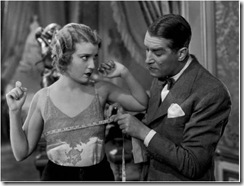
The “Baron” Gaston Monescu (Marshall) and “Countess” Lily Vautier (Hopkins) first meet in Venice, where Lily pretends she’s ashamed to be seen going into his hotel room—but not ashamed enough to try to look inconspicuous. The gown that Hopkins is wearing couldn’t have been any tighter trouble3without her breaking a rib. Add the fact that it’s one of those shimmering, backless numbers and you see how one might doubt her meek manner. Anyway, as they are dining in his hotel room and enjoying a bit of sexual repartee, word gets around that there have been a number of robberies in the hotel. As each criminal tries to outwit the other, the truth dawns on Lily and she nonchalantly calls him a crook and then asks him to pass the salt. Thus, each reveals what they have stolen from the other, which serves as a strange form of foreplay for the couple and they declare their love. This scene is sleek, sexy, and sophisticated.

The story then moves to Paris, where we meet Madame Mariette Colet (Francis), the widowed owner of the Colet Perfume kay Company. Rich beyond compare, she pays 125,000 francs for a diamond-encrusted evening bag, Mariette is a bored and frivolous woman. Her two would-be suitors, Francois (Edward Everett Horton) and the Major (the always delightful Charles Ruggles), vie for her time and affections. Sometimes they even go on dates together, such as to the opera where Mariette has her 125,000 franc purse stolen. Guess who was in the audience that same night?

Time has not been kind to Gaston and Lily. He hit a snag in Geneva and their finances are not what they once were. As a result, the passion has dimmed a bit. When Lily reads in the newspaper about a 20,000 francs reward for the return of Mariette’s lost purse she urges Gaston to turn it in for the reward—he has bigger plans.

When Gaston goes to return the purse he saves Mariette from an angry Bolshevik and endears himself to her. Of course, now he’s Monsieur LaValle—he needs to be incognito since that nasty Geneva incident. He tells Mariette that he only accepts the reward due to the stock market crash. Unable to find her checkbook, Mariette is persuaded by Gaston to look in her wall safe. troubleinparadise Obliviously she opens it in front of him, and he stores the combination in his thieving mind. No checkbook, but there is 100,000 francs on hand—if only we all had that problem! It would seem that Mariette isn’t used to handling such issues, but since she discharged her secretary she’s been a bit disorganized. Well, Gaston needs a job and she likes the way he tells her she has no business sense. Voila—Gaston is now her personal secretary—no references please! In short fashion he positions himself as the most powerful person in the Colet house, even more so than Madame herself.

Since Mariette is useless when it comes to business and Gaston is responsible for everything, he needs an assistant. And, so, Lily comes to Chateau Colet and works with Gaston to convince Mariette to keep 850,000 francs in her safe. Lily is no longer dressed in slinky dresses but in unflattering suits.When Mariette suggests that Lily do more of Gaston’s work and that she leave at 5 p.m. every day, Lily becomes convinced that her new boss is out to get her man. Jealous and convinced Gaston is sexually involved (or soon to be) with Mariette, Lily tries to convince Gaston to leave with what is already in the safe. When he says they need to hold out a bit longer, Lily begs him to remain a crook but not to become a “good for nothing gigolo.”

Each day after Lily goes home at 5 p.m., Mariette draws Gaston closer and closer to her. Eventually it becomes obvious that they are involved and Lily starts to become bitterly jealous. If Lily wasn’t problem enough, Gaston has to deal with Francois, one of his victims in Venice. While Francois can’t place Gaston he has a feeling they’ve met before. In addition, the chairman of Mariette’s company, Monsieur Giron (C. Aubrey Smith), is convinced Gaston is an imposter. Eventually, Francois remembers where he’s seen Gaston after snuffing a cigarette in a gondola-shaped ashtray. Somehow Gaston distracts Francois and he forgets to accuse Gaston of wrongdoing. Gaston alerts Lily to the end of the grift and books train tickets to Berlin.

francis_marshall_tip_1932 The last section of this film is the best. When Gaston plans to rob the safe while Mariette attends a dinner party, Lubitsch throws in one of his best twists. With a servant awaiting orders about the car, the couple argue over whether she is to go to the party or stay. Taking control for once in her life, Mariette decides to take Gaston as her lover and even snaps her fingers at him to show how quick she can have him. Later, they both emerge from her bedroom door in plain sight of the chauffeur, who is finally told by Gaston that Madame won’t need the car. Oh, but, yes, she will, says Madame. This is priceless. Evidently, Gaston will have to wait until 11 p.m.—but he has to catch the midnight train to Berlin with Lily! He calls her and announces they won’t be leaving until the morning.

While Mariette is at the party, Giron arrives and informs Gaston that he must leave the chateau by the next morning unless he wants the police introduced to Gaston Monescu. Unfortunately for Giron, Gaston has uncovered that he’s been embezzling from the company. With this out of the way, now Gaston must deal with an angry and jealous Lily, who comes to collect her share of the take and to leave Gaston forever.

Meanwhile at the party, Francois’ memory is restored when he hears the word “doctor” and remembers who Gaston is. He informs Mariette, who returns to the chateau just as Lily is leaving. She immediately goes to Gaston’s bedroom Troublewand starts taking off her clothes and jewelry. When she goes to place her jewels in the safe Gaston attempts to distract her by telling her of Giron’s embezzlement. Eventually he reveals that he is a crook, but that he loves her, too. Distressed, Mariette returns to her own room to find Lily waiting for her. In a deft move, Lily informs Mariette that she’s the one who robbed the safe and that she is Gaston’s former lover. In one of Miriam Hopkins’ best scenes of all time (not that there are many), she first throws the money back at Mariette and then decides if Mariette can pay 125,000 francs for a handbag she can afford to pay 100,000 for Gaston—thus making him a gigolo. This makes Gaston realize he loves Lily. He bids farewell to Mariette, and she bids farewell to her pearl necklace—a willing gift to Lily.

tr In the final scene of the film we find the thieves in the back of a taxi cab, making their way to the train station. When Gaston searches for the necklace, Lily reveals she’s already pick-pocketed it and that she took the 125,000 handbag as well—now will he deposit the 100,000 that he took out of her purse.

The dialogue and the story are wonderful. You can’t beat a Lubitsch film when it comes to witty dialogue. He may have not written the screenplay, that marvelous piece of work belongs to Grover Jones, but he had an ear for what worked best and how and at what pace it should be delivered.

Herbert Marshall is his usual charming and suave self. If you’ve seen him in The Letter, then you are familiar with his range. As for Miriam Hopkins, she is bearable. I don’t care for her at all. There is something that always rubs me the wrong way when I watch her in a film. I suppose this is her best performance, but as I’ve already said, there’s not much to choose from. My favorite scenes in the film all have Kay Francis in them. I think she is absolutely wonderful in this role and if it were up to me, Gaston would have stayed right there in her bedroom. The idea that he’d leave her for Miriam Hopkins almost ruins the film. It sort of reminds me of how I felt at the end of Four Weddings and a Funeral. I was so mad when Hugh Grant’s Charles ended up with Andie MacDowell’s Carrie, when he should have realized the best woman for him was Kristin Scott Thomas’ Fiona. Am I the only one who feels this way about these two films?

Finally, while I like this movie, it is not my favorite Lubitsch film. I much prefer Ninotchka. Still, Trouble in Paradise is an enjoyable film that all fans of sophisticated comedy should see.
Read More
Posted in **, 1932, Lubitsch (Ernst) | No comments

Wednesday, January 27, 2010

I Am a Fugitive from a Chain Gang (1932) **

Posted on 7:44 AM by Unknown

i-am-a-fugitive-from

Get your mind out of the gutter—I’m not that type of girl!

Paul Muni plays James Allen, a returning WWI GI who finds unemployment and then is unjustly convicted of theft and sent to a southern prison to serve on a chain gang, in this classic 1932 film directed by Mervyn LeRoy. One of Warner Bros. social conscience films, and the recipient of three Academy Award nominations (Best Picture, Best Actor (Muni), and Best Sound), the film depicts the harsh world of the southern penal system in the 1920s. Based on the autobiographical story of Robert E. Burns, a man who became a fugitive from a Georgia chain gang, this is an excellent indictment of an abusive prison system.

When James Allen returns home from the Great War he wants to do more than go back to his clerk job in a shoe factory. Instead he wants to go to engineering school so he can build bridges. The problem is his mother (Louise Carter) and his reverend brother (Hale Hamilton) want him to stay at Mr. Parker’s (Reginald Barlow) shoe factory and pick up where he left off before the war. Not the arguing kind, he finds himself back at that factory, but is distracted by a bridge being built outside his office window and he decides to head north to find construction work. This sets him off on a transient existence, moving from place to place looking for work. Things become so bad that he tries to pawn his war medals to no avail; the owner already has a drawer full—a nod to the dire circumstances that war veterans faced at that time.

Eventually he finds himself back in the South and ends up meeting Pete (Preston Foster), the man who will fatefully change his life forever. When they go to a diner for hamburgers, Pete pulls a gun and orders a bewildered Allen to take the money from the till (a whopping $5). When the police arrive they kill Pete and assume Allen was his accomplice. He is convicted of armed robbery and sentenced to ten years of hard labor. i-am-a-fugitive-from-a-chain-gang-800-75 Now, Allen is the member of chain gang that manually splits boulders at a rock pit. He endures blazing heat, vindictive guards, and substandard food and living conditions. When Allen makes the mistake of coming to the defense of another prisoner, he is flogged in his place. Though the actual beating takes place off-screen, LeRoy uses shadow silhouettes and agonizing screams to make his point.

After seven months of relentless work on the chain gang, Allen decides to escape. He has a fellow prisoner bend his shackles so he can slide it off his foot and he borrows $7 and the address of a former inmate from another. While taking a bathroom break in the bushes, Allen slips off his shackles and sets off for freedom. He exchanges his prison clothes for some hanging on a clothesline and uses the swamp to evade the bloodhounds. In an often imitated scene, Allen uses a hollow reed to breathe underwater while guards and digs pass by.

Allen ends up in Booneville and meets up with Barney, a former inmate who gives him a place to sleep for the night. The next day while he is waiting for a train he orders a hamburger (evidently bad luck for him) and hears that the police are looking for the escaped prisoner. In a near-miss episode, Allen finds himself scrambling onto a train as the police point in his direction but run past him for another man.

Free, Allen journeys to Chicago, where he gets a job (under an alias) at the Tri-State Engineering Company and works his way up the company ladder. He ends up boarding with a scheming landlady, Marie (Glenda Farrell), FUGMarieFightwho sees a man on the rise and sets her cap for him. When Allen works his way up to a supervisor position he decides to get another place to live. This angers Marie and she reveals to Allen that she knows about his past and blackmails him into marrying her.

After years of hard work and study, Allen become a field superintendent and falls in love with Helen (Helen Vinson). Yet, he can’t get rid of Marie, who doesn’t care that he loves another woman. When he threatens her with a divorce she turns him in and he is arrested. His friends and the newspapers try to block his extradition to the South, especially after he describes how horrible the chain gang is. This causes a min-civil war between the northern and southern justice systems. Finally, Allen agrees to return to the prison for ninety days to work as a clerk, where thereafter he would be given a full pardon.

Once back in prison, Allen soon learns that this agreement won’t be kept by the Tuttle County Prison Camp. Instead, he is assigned to even harsher chain gang than before. After 90 days, his pardon hearing reveals that the state is angry with his public criticisms of their justice system and his pardon is denied but he is given the option of parole in nine months. Allen resigns himself to this nine month fate and is a model prisoner. Yet, when his case comes up fuge again and a decision is suspended indefinitely, Allen decides he has to attempt another escape. He and another inmate escape the chain gang and steal a truck carrying dynamite, which they use to blow up a bridge to cut off the guards. It is interesting to note that LeRoy used the image of the blown up bridge to illustrate that Allen had now burned all his bridges of ever living a normal life again. A year later, we find Allen ragged and hunted. In a final meeting with Helen, he explains that they can never meet again. In one of the crueler instances of movie fate, when iamafugitiveisteal_vd_120x60_022420091205 Helen asks him how he lives, he answers, “I steal.” All of this misery over $5! You won’t forget the image of this last scene.

This is the granddaddy of prison-break films. When you watch Cool Hand Luke, The Defiant Ones, or O Brother Where Art Thou?, you are watching films inspired by this one. It unapologetically exposed the horror of a system of forced labor in the South, which ground men down into nothing or into their graves. It angered southerners so much that it was actually banned in Georgia—where the real-life story of Robert E. Burns took place.

Paul Muni is excellent as a man who wants nothing more than to be a productive member of society. He always had the ability to encompass the true nature of all the characters he played, whether it be an escaped convict or Prime Minister Disraeli. In addition, the maliciousness of Glenda Farrell as Marie is something to watch.

A classic prison break film and one of Muni’s best performances.

Read More
Posted in **, 1932, LeRoy (Mervyn) | No comments

Sunday, January 24, 2010

Boudu Saved From Drowning (1932) **

Posted on 3:09 AM by Unknown

boudusavedfromdrowning

Are you someone who saw Down and Out in Beverly Hills back in 1986 (attired in some form of stone-washed denim or Lycra skirt) and thought it was hilarious? Yet, somehow, today if someone were to mention it you would say it was terrible and that contrary to what others might say, you never crimped your hair or made the mistake of thinking hair mousse was edible. Oh, the inescapable 80s.

Down and Out in Beverly Hills was a remake of this 1932 French black comedy directed by Jean Renoir and starring the irreverently funny Michel Simon as Boudu. Based on a play by René Fauchois, the story follows Boudu, a dirty, shaggy bum, who is saved from drowning himself in the Seine by bourgeois Parisian bookseller Edouard Lestingois (Charles Granval). The Lestingois family decides to adopt Boudu and make him a “respectable” member of society. They takes him into their home and he (and we) learn just how respectable middle-class Parisian society is!

It would seem that the respectable Edouard boudu302 is a gentleman. He has a family, a business, and a maid (Séverine Lerczinska), who also happens to be his mistress. At first, his prim and proper wife (Marcelle Hainia) is disgusted by Boudu’s hygiene and poor table manners. Yet, over time she becomes strangely attracted to Boudu (after a haircut) and they have an affair. Meanwhile, Edouard can’t understand why Boudu isn’t more grateful to him for saving him and giving him a chance at respectability. Instead, what he finds is ingratitude from a man who just keeps asking him for more of everything: clothes, food, and money (as well as his wife). What’s comic about Edouard’s bewilderment is that Boudu has become just like him and, in a way, is unhappy. Another humorous turn happens when Boudu finds lottery tickets in one of the jackets Edouard gives him. When he shows them to Edouard the bookseller tells him to keep one for himself. This turns out to be a one-hundred thousand franc winner. With his newfound wealth Boudu is now respectable boudu310 and marries the maid. Yet, at their wedding party something strange happens. While riding a skiff down the Seine, Boudu reaches down for a water lily and causes the skiff to overturn. While the wedding party swims to the banks, Boudu lets the current carry him away from them. He happily returns to his old, carefree life. In the end, he is saved from drowning in bourgeois respectability.

This film was not released in the United Stated until 1967, but when it got here it became an art house staple. What attracts most to this film is its biting criticism of middle class respectability. It was so scathing that it was banned in France only after a few days in release. Today it seems ridiculous that such a film could get banned, but evidently middle class Parisians couldn’t handle the truth of what they were really like.

Michel Simon is a comic genius as the bou unkempt Boudu. My favorite scene is when instead of spitting on the floor because he was told it was rude, he spits in a copy of Balzac's Physiology of Marriage. You need only know that the sub-title was Petty Troubles of Married Life to get the joke. Throughout the film Simon displays his adeptness at physical comedy and his perfect comic timing.

One of the things I most remember about the film is how Renoir shot the scenes at the Lestingois’ home and business. Most of the shots are very tight and the set is over-cluttered, which gives these scenes a claustrophobic feel. No doubt, Renoir was making a statement with this approach. And when you contrast the interior scenes to the exterior ones, which are airy and full-framed, you see an entirely different world.

Biting and irreverent, this is a black comedy worth watching.

Read More
Posted in **, 1932, Renoir (Jean) | No comments

Friday, January 22, 2010

Love Me Tonight (1932) **1/2

Posted on 3:41 AM by Unknown

LoveMeTonight

But what about tomorrow?

Directed by Rouben Mamoulian, this 1932 romantic musical set the bar very high for subsequent musicals. Many critics cite it as one of the greatest and innovative musicals of the 1930s. Song and dialogue are cleverly woven together to tell the unlikely love story of a very frustrated Princess Jeanette (Jeanette MacDonald) and a handsome Parisian tailor named Maurice (Maurice Chevalier).

The beginning of the film is unforgettable, with a symphony of noises that captures the sounds of an awakening Paris and Chevalier singing “That’s the Song of Paree”. We learn that Maurice has just completed a job that will establish him as a first-rate tailor: 15 suits for the Viscount de Varese (Charlie Ruggles). The problem is the viscount can’t pay hLove%201is bill, as he is financially dependent on his uncle the Duke (C. Aubrey Smith). While discussing his problem with his friend Emile they get on the topic of love and Maurice begins singing, “Isn’t It Romantic?” This launches one of the greatest musical numbers to grace the silver screen. Because the tune is so catchy it sticks in Emile’s head, and when he leaves the shop he starts humming it and as he does this it is picked up by a taxi driver and his composer passenger, who takes the song on a train where soldiers hear it and use it as they march in the fields, where a gypsy hears it and plays it on his violin back to his camp, where it finally carries over to the de Varese estate of Princess Jeanette, who sings it on her balcony. This song and its far-flung travels, now links Maurice and Jeanette even before they have met. The passing of the song from person to person was seamless and very cleverly done—sort of like what will later take place in Gigi.

The Princess it would seem is very unhappy and well, sexually frustrated. Just 22, she is the widow of a very old man. If she is to marry again she must find someone of equal royal rank, but this holds problems in itself, as there are only two eligible suitors: ages 85 and 12. What is an attractive widow to do?

While the Princess is busy being bored at the chateau, Maurice decides to take the Count’s 11932: Myrna Loy (1905 - 1993) looks up at Charles Ruggles (1886 - 1970), the American character comedian in a scene from 'Love Me Tonight', directed by Rouben Mamoulian for Paramount.5 suits to the estate and collect payment. When he arrives at the chateau and gives his name, Maurice Courtelin, he is mistaken for a Baron Maurice Courtelin. He meets the princess and immediately falls in love with her. Not knowing he’s just a lowly tailor, the family and their guests are enamored with him and his singing of "Mimi"—so much so that they all begin singing it. The only two people who don’t quickly embrace his charms are the Princess and her would-be suitor the Count de Savignac (Charles Butterworth). One particular person who finds him irresistible is the Countess Valentine (Myrna Loy, in an outlandishly funny turn), who seems to be nymphomaniac. It was enjoyable to watch Loy as a man-hungry woman chasing after Maurice—especially when you consider Chevalier’s reputation as a ladies man.

chevalierSomehow a rumor emerges that Maurice is not a baron but a full-blooded prince traveling incognito. This changes everything and sends hope to the Princess, who now allows herself to open up to the charming Maurice. What is a love-stricken tailor to do? It’s obvious that she can’t marry a commoner…let alone a a common tailor. Will he tell her the truth? In the end all is revealed, but love conquerors all.

All together there are nine fantastically staged musical numbers by Richard Rogers and Lorenz Hart. The songs are extremely catchy. If you have seen this film, you might just be humming “Mimi” or “Isn’t It Romantic” as you read this. lo1 Both MacDonald and Chevalier are delightful singers and carry their songs off very well. Some of the lyrics are quite racy for 1932, but somehow most of them, along with the double-entendre laden dialogue, got past censors—though 15 minutes did get cut (one can only wonder how far Mamoulian actually tried to go). In addition, the supporting cast of Myrna Loy, Charles Ruggles, and C. Aubrey Smith are tremendous.

If you love musicals, you will love this movie. A thoroughly enjoyable classic.

Read More
Posted in **1/2, 1932, Mamoulian (Rouben) | No comments

Tuesday, January 19, 2010

Vampyr (1932) *1/2

Posted on 2:29 AM by Unknown

vampyr-1932-horror-movie-review-38711

If only the scythe had come before I watched this!

Some critics regard this 1932 gothic horror film Danish director Carl Theodor Dreyer’s greatest work and one of the greatest horror films of all time. I don’t know if I’m actually an expert, but I have to strongly disagree. I think his The Passion of Joan of Arc is truly a good film, but I hated Vampyr. The way Dryer incorporates imagery is interesting, but the story was just too all over the place for me.

Based on the Sheridan Le Fanu short story”Carmilla,” the film follows traveler David Gray (Julian West) to a a provincial village outside Pairs, where a series of supernatural murders are taking place. Thinking the villagers ignorant and superstitious, David soon learns what happens in this village is no joking matter. vampyr-gerard

A series of strange (and at times unexplainable) incidents befall David. Whilst sleeping at an inn, David is awakened by a man (whom he doesn’t know) who places a packet in his room that reads: To Be Opened upon My Death. Later, David follows shadows to an old castle where other shadows are dancing. This is where he sees a doctor (Jan Hieronimko) and an old and not so attractive woman (Henriette Gerard), who we will later learn is Marguerite Chopin, but more importantly, both are vampyrs. As he walks to a nearby manor David sees the man who left the package in his room. Suddenly, the man is shot dead and David is ushered into the manor by servants. He is invited to stay the night and he meets Gisele (Rena Mandel) and her seriously ill sister, Leone (Sybille Schmitz).

After finding Leone lying unconscious outside the house with bite wounds, David remembers the mystery package. When he opens it he finds a book about vampyrs. As he reads it he realizes Leone VAMPYRhas been the victim of one of these demonic creatures. When it is determined by the doctor that Leone must have a blood transfusion to survive, David offers his. This drains David of all his energy and he settles down to restless sleep. He awakens suddenly, sensing danger, and goes to Leone’s room to find the doctor about to poison her and Gisele missing. David pursues him to the castle, where he has a vision of being buried alive. After this unpleasant vision ends, David rescues Gisele, but the doctor gets away.

When a servant reads in the vampyr book that the only way to kill a vampyr is to put an iron bar through its chest, he and David go to Marguerite Chopin's grave. When they open her grave they find her creepily laying there and they kill her with an iron bar. They then track the doctor to a mill and somehow suffocate him to death with flour—I guess this kills vampyrs, too? The vampyr curse is lifted and Leone is saved. And, in one of the most bizarre endings I can think of, David and Gisele somehow end up in a boat on a fog-laden river and then find themselves coming into a bright clearing. Was it all just a dream? Your guess is as good as mine.

There are no explanations to what transpires in this movie; things just happen. The imagery of the menacing scythes, eerie fog, and silhouette shadows are cavampyr3ptivating, but that’s the only thing I found appealing. Dreyer definitely creates a very austere and sterile setting: it looks and sounds like a gothic horror movie. Yet, I was just too confounded by the strange narrative that Dreyer chose to follow. My rule about film is this: if after watching a film you ask yourself at the end, “What the hell was that?”, then it wasn’t good.

Some like, and even love, it—I did not. I most assuredly could have died without having seen it.

Read More
Posted in *1/2, 1932, Dreyer (Carl Theodor) | No comments
Older Posts Home
Subscribe to: Posts (Atom)

Popular Posts

  • Mishima: A Life in Four Chapters (1985) **
    On the morning of November 25, 1970, Yukio Mishima (Ken Ogata) was recognized as Japan’s greatest modern writer. By the end of the day he w...
  • Slacker (1991) :(((
    I graduated from high school the year director Richard Linklater’s Slacker (1991) came out.  I unequivocally knew no one who resembled the ...
  • Dodsworth (1936) **
    (This is my contribution to the Mary Astor Blogathon, hosted by Tales of the Easily Distracted and Silver Screenings. Please follow this lin...
  • To Kill a Mockingbird (1962) **1/2
    Who doesn’t wish their father was a little bit (or maybe a lot) like Atticus Finch (Gregory Peck)? Kind, soft-spoken, principled, honorable...
  • Sunset Boulevard (1950) ***
    Before there was The Artist (2011) there was director Billy Wilder’s Sunset Boulevard (1950). Both movies shine a very bright light on ...
  • The Crowd (1928) **1/2
    We are born just like everyone else, right? So, why do we always think we are "special"? That’s the question director King Vidor ...
  • Grave of the Fireflies (Hotaru No Haka) 1988 **
    Suffice to say, Japanese animation would have made Walt Disney both proud and sad at the same time.  Aesthetically beautiful, but just so d...
  • The Mortal Storm (1940) ***
    Released more than one year before Pearl Harbor, director Frank Borzage’s The Mortal Storm (1940) was a Hollywood rarity—it openly critici...
  • Ninotchka (1939) ****
    When MGM marketed director Ernst Lubitsch’s political satirical 1939 comedy, Ninotchka , they used the catchphrase, “Garbo laughs”. While G...
  • Daybreak (Le jour se lève) 1939 **
    There are two important, though strange, reasons why director Marcel Carné’s Le jour se lève ( Daybreak , 1939) is still considered an imp...

Categories

  • :(((
  • *
  • **
  • ***
  • ****
  • ***1/2
  • **1/2
  • *1/2
  • 1902
  • 1903
  • 1915
  • 1916
  • 1919
  • 1920
  • 1921
  • 1922
  • 1923
  • 1924
  • 1925
  • 1926
  • 1927
  • 1928
  • 1929
  • 1930
  • 1931
  • 1932
  • 1933
  • 1934
  • 1935
  • 1936
  • 1937
  • 1938
  • 1939
  • 1940
  • 1941
  • 1942
  • 1943
  • 1944
  • 1945
  • 1946
  • 1947
  • 1948
  • 1949
  • 1950
  • 1951
  • 1953
  • 1954
  • 1955
  • 1956
  • 1957
  • 1959
  • 1960
  • 1962
  • 1963
  • 1964
  • 1965
  • 1966
  • 1967
  • 1968
  • 1969
  • 1970
  • 1971
  • 1972
  • 1973
  • 1975
  • 1976
  • 1977
  • 1978
  • 1979
  • 1980
  • 1981
  • 1982
  • 1983
  • 1985
  • 1986
  • 1987
  • 1988
  • 1989
  • 1991
  • 1992
  • 1993
  • 1994
  • 1995
  • 1996
  • 1998
  • 1999
  • 2000
  • 2002
  • 2004
  • 2005
  • 2006
  • 2007
  • 2010
  • 2011
  • 2012
  • Akerman (Chantal)
  • Aldrich (Robert)
  • Aleksandrov (Grigori)
  • Alfredson (Tomas)
  • Allen (Woody)
  • Antonioni (Michelangelo)
  • Arbuckle (Fatty)
  • Argento
  • Arliss (Leslie)
  • Aronofsky (Darren)
  • Arzner (Dorothy)
  • Bacon (Lloyd)
  • Beauvois (Xavier)
  • Becker (Jacques)
  • Bergman (Ingmar)
  • Berkeley (Busby)
  • Bertolucci (Bernardo)
  • Bigelow (Kathryn)
  • Blystone (John G.)
  • Borzage (Frank)
  • Brown (Clarence)
  • Browning (Tod)
  • Bruckman (Clyde)
  • Buñuel (Luis)
  • Camus (Marcel)
  • Capra (Frank)
  • Carné (Marcel)
  • Carpenter (John)
  • Chaney (Lon)
  • Chang Cheh
  • Chaplin (Charles)
  • Christensen (Benjamin)
  • Clair (René)
  • Clark (Bob)
  • Cleese (John)
  • Cline (Edward F.)
  • Clouse (Robert)
  • Cocteau (Jean)
  • Coen Brothers
  • Cooper (Merian)
  • Crichton (Charles)
  • Crosland (Alan)
  • Cukor (George)
  • Curtiz (Michael)
  • de Antonio (Emile)
  • Demy (Jacques)
  • Dieterle (William)
  • Dmytryk (Edward)
  • Donen (Stanley)
  • Dovzhenko (Aleksandr)
  • Dreyer (Carl Theodor)
  • Dulac (Germaine)
  • Duvivier (Julien)
  • Eisenstein (Sergei M.)
  • Fellini (Federico)
  • Feuillade (Louis)
  • Fincher (David)
  • Flaherty (Robert J.)
  • Fleming (Victor)
  • Ford (John)
  • Fosse (Bob)
  • Frankenheimer (John)
  • Friedkin (William)
  • Gance (Abel)
  • Garnett (Tay)
  • Gibson (Mel)
  • Godard (Jean-Luc)
  • Griffith (D.W.)
  • Guitry (Sacha)
  • Haines (Randa)
  • Hamilton (Guy)
  • Haneke (Michael)
  • Hathaway (Henry)
  • Hawks (Howard)
  • Hazanavicius (Michel)
  • Herzog (Werner)
  • Hill (George Roy)
  • Hitchcock (Alfred)
  • Hooper (Tom)
  • Howe (J.A.)
  • Huston (John)
  • Ivory (James)
  • Jeunet (Jean-Pierre)
  • Jewison (Norman)
  • Jonze (Spike)
  • Julian (Rupert)
  • Kachyňa (Karel)
  • Kazan (Elia)
  • Keaton (Buster)
  • Keighley (William)
  • Kelly (Gene)
  • Kershner (Irvin)
  • Kieslowski (Krzysztof)
  • Kim (Sang-jin)
  • Kim Ki-duk
  • King Hu
  • Kubrick (Stanley)
  • Kurosawa (Akira)
  • La Cava (Gregory)
  • Lang (Fritz)
  • Laughton (Charles)
  • Lean (David)
  • Lee (Ang)
  • Lee (Spike)
  • Leone (Sergio)
  • LeRoy (Mervyn)
  • Linklater (Richard)
  • Lloyd (Frank)
  • Lubitsch (Ernst)
  • Luhrmann (Baz)
  • Lumet (Sidney)
  • Luske (Hamilton)
  • Ma-Xu Weibang
  • Mamoulian (Rouben)
  • Mankiewicz (Joseph L.)
  • Mann (Anthony)
  • Marshall (George)
  • Maysles Brothers
  • McCarey (Leo)
  • McLeod (Norman Z.)
  • McQueen (Steve)
  • Méliès (Georges)
  • Melville (Jean -Pierre)
  • Mendes (Sam)
  • Menzies (William Cameron)
  • Meyer (Russ)
  • Micheaux (Oscar)
  • Milestone (Lewis)
  • Minnelli (Vincent)
  • Mizoguchi (Kenji)
  • Moland (Hans Petter)
  • Morris (Chris)
  • Mulligan (Robert)
  • Murnau (F.W.)
  • Nichols (Mike)
  • Nolan (Christopher)
  • Olivier (Laurence)
  • Ophüls (Max)
  • Osten (Franz)
  • Ozu (Yasujiro)
  • Pabst (Georg Wilhelm)
  • Pagnol (Marcel)
  • Peckinpah (Sam)
  • Peixoto (Mario)
  • Peli (Oren)
  • Petersen (Wolfgang)
  • Polanski (Roman)
  • Ponting (Herbert G.)
  • Porter (Edwin S.)
  • Powell and Pressburger
  • Preminger (Otto)
  • Pudovkin (Vsevolod)
  • Raimi (Sam)
  • Redford (Robert)
  • Reed (Carol)
  • Reggio (Godfrey)
  • Reiniger (Lotte)
  • Reisner (Charles)
  • Renoir (Jean)
  • Resnais (Alain)
  • Riefenstahl (Leni)
  • Robinson (Bruce)
  • Robson (Mark)
  • Rossellini (Roberto)
  • Sandrich (Mark)
  • Sayles (John)
  • Schoedsack (Ernest B.)
  • Schrader (Paul)
  • Scorsese (Martin)
  • Scott (Ridley)
  • Seiter (William A.)
  • Sharpsteen (Ben)
  • Sheridan (Jim)
  • Sherman (Lowell)
  • Sirk (Douglas)
  • Sjöström (Victor)
  • Sluizer (George)
  • Smith (Jack)
  • Spielberg (Steven)
  • Stevens (George)
  • Sturges (Preston)
  • Takahata (Isao)
  • Tati (Jacques)
  • Taviani Brothers
  • Téchiné (André)
  • Tourneur (Jacques)
  • Ulmer (Edgar G.)
  • Van Dyke (W.S.)
  • Varda (Agnes)
  • Vertov (Dziga)
  • Vidor (Charles)
  • Vidor (King)
  • Vigo (Jean)
  • von Sternberg (Josef)
  • von Stroheim (Erich)
  • Waggner (George)
  • Walsh (Raoul)
  • Weir (Peter)
  • Welles (Orson)
  • Wellman (William A.)
  • Whale (James)
  • Wiene (Robert)
  • Wilde (Ted)
  • Wilder (Billy)
  • Wise (Robert)
  • Wood (Sam)
  • Wyler (William)
  • Yonggang (Wu)
  • Zwerin (Charlotte)

Blog Archive

  • ▼  2014 (43)
    • ▼  July (4)
      • Voyage to Italy (Viaggio in Italia) 1953 **
      • An American in Paris (1951) **
      • Jeanne Dielman, 23, Quai du Commerce, 1080 Bruxell...
      • Guys and Dolls (1955) **1/2
    • ►  June (22)
    • ►  May (4)
    • ►  April (2)
    • ►  March (4)
    • ►  February (4)
    • ►  January (3)
  • ►  2013 (69)
    • ►  December (2)
    • ►  October (6)
    • ►  September (7)
    • ►  August (6)
    • ►  July (7)
    • ►  June (7)
    • ►  May (6)
    • ►  April (7)
    • ►  March (7)
    • ►  February (7)
    • ►  January (7)
  • ►  2012 (59)
    • ►  December (2)
    • ►  November (3)
    • ►  October (4)
    • ►  September (10)
    • ►  August (5)
    • ►  July (3)
    • ►  June (5)
    • ►  May (1)
    • ►  April (4)
    • ►  March (8)
    • ►  February (5)
    • ►  January (9)
  • ►  2011 (54)
    • ►  December (1)
    • ►  November (3)
    • ►  October (6)
    • ►  September (3)
    • ►  July (1)
    • ►  April (3)
    • ►  March (12)
    • ►  February (14)
    • ►  January (11)
  • ►  2010 (86)
    • ►  December (2)
    • ►  November (5)
    • ►  October (2)
    • ►  August (1)
    • ►  July (3)
    • ►  June (5)
    • ►  May (6)
    • ►  April (3)
    • ►  March (2)
    • ►  February (2)
    • ►  January (55)
Powered by Blogger.

About Me

Unknown
View my complete profile